
The enhancement of combat capability by the two armies in the region came even as both the countries continued their efforts to resolve the dispute through talks at military and diplomatic levels.
At an online media briefing, External Affairs Ministry Spokesperson Anurag Srivastava gave a run down of the events along the LAC in the eastern Ladakh region and held China responsible for the Galwan Valley clashes off June 15.

The Indian Army has deployed a significant number of easily transportable M-777 ultra-light howitzers in mountainous regions along the Line of Actual Control (LAC) in Arunachal Pradesh, military officials said on Thursday.

The increase in India's military spending was "mainly a result of growing personnel and operations costs" which made up almost 80 percent of the total military budget in 2023, the SIPRI report claimed.

The shelters were installed in locations near Tashigong, Manza, Hot Springs and Churup among others, in reflection of simmering tensions between the two sides in the region.
'China and India have encountered some setbacks in recent years which do not serve the fundamental interests of the two countries and the two peoples'

The Congress alleged that whenever an issue of national security comes up, the "prime minister hides behind his ministers".

"The contents of video being circulated are not authenticated. Attempt to link it with the situation on the Northern borders is mala fide," the army said in a statement. It said differences between the two sides are being addressed through interaction between military commanders following established protocols on management of border between the two countries.
Asked about the reports of the troops on both sides disengaging and moving back to their previous positions, Chinese foreign ministry spokesperson Hua Chunying told a media briefing in Beijing that both sides are taking steps to ease the situation along the borders.
Over the last few weeks, bipartisan support for India against China has been increasing.
The Chinese action followed 'India's recent, illegal construction of defence facilities across the border into Chinese territory in the Galwan Valley region', a write-up in the state-run Global Times tabloid said, quoting unnamed military sources.

China has chosen to keep New Delhi guessing, while retaining for itself the option of constantly changing facts on the ground and shifting the LAC westwards -- the strategy called 'salami slicing', notes Ajai Shukla.
China on Thursday said Chinese and Indian troops have taken "effective measures" to disengage at the Galwan Valley and other areas along the Line of Actual Control in eastern Ladakh and the situation is "stable and improving," days after the two sides agreed on an expeditious withdrawal of soldiers from all the standoff points.

Chief of Army Staff Gen Manoj Pande has carried out a comprehensive review of India's military preparedness along the Line of Actual Control (LAC) in Arunachal Pradesh in his first visit to the border state after last month's clash between Indian and Chinese forces in the Tawang sector.

The two sides are also expected to finalise a roadmap for restoration of peace and tranquility in the high-altitude region that witnessed an eight-week bitter standoff between the troops of the two countries.

The two sides held diplomatic talks through video conference on the border standoff in midst of fresh details emerging that China has strengthened its position in several areas in eastern Ladakh including Galwan Valley where a violent clash on June 15 left 20 Indian soldiers dead.

The frontline troops of China and India have "completed" disengagement at most locations of their border, a senior Chinese official said on Tuesday, adding the situation on the ground is easing.

China plans to build a new highway along the Line of Actual Control (LAC) with India as part of Beijing's efforts to strengthen its strategic position and project its power, a media report said on Wednesday.
'Anyone familiar with Modi's track record will know he never forgets a slight, a betrayal,' notes Virendra Kapoor.
The talks came a day after the two armies began a limited disengagement in a few areas in Galwan Valley and Hot Spring in a demonstration of their intent to end the row peacefully.
Within the army, there is growing concern that New Delhi will allow the Chinese to retain the territory they have occupied in the last month.
'We are beginning to see that the rest of the world will not simply accept the domination of one power'

Jaishankar said the last few years have been a "period of serious challenge", both for the relationship and for the prospects of Asia, noting that continuation of the current impasse will not benefit either India or China.

The Chinese aren't after territory. Their target is our national will, morale and the sense of autonomy we feel in making our strategic choices. They are attacking India and the Modi government at their weakest point, asserts Shekhar Gupta.
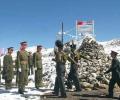
The two sides have already held at least 12 rounds of talks between local commanders and three rounds of talks between major general-rank officials but no positive outcome came out from the discussions, they said.

Had it not been for the slow but sure emergence of China as a threat to the western order, would India have been accepted as a near-equal partner by individual western nations, jointly and severally, questions N Sathiya Moorthy.

Spokesperson in the MEA Anurag Srivastava said both sides have agreed to work for an early resolution to the issue in keeping with broader guidance provided by leaders of the two countries for ensuring peace and tranquillity along the border areas. He, however, did not respond to questions relating to reports of pulling back of troops by both India and China from certain friction points in the Galwan Valley and Hot Spring areas in eastern Ladakh in the last few days.

People took to the streets in New Delhi, Mumbai, Ahmedabad, Jammu, Bhopal, Patna and other cities and set fire to the Chinese flag and photos of the neighbouring country's President Xi Jinping. Protesters urged the Modi government to ensure that martyrdom of the soldiers in the Galwan Valley did not go in vain.

The meeting started at around 11.30 am at Moldo on the Chinese side of Line of Actual Control (LAC) opposite Chushul to defuse the tensions in Eastern Ladakh sector due to Chinese military build-up, the sources said. This is the second meeting between the two corps commanders.
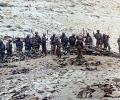
Sources said the Chinese had come heavily prepared but did not expect the Indian side to be well prepared.
During their hour-long in-person meeting on the sidelines of a Shanghai Cooperation Organisation (SCO) conclave in Dushanbe on Wednesday, External Affairs Minister S Jaishankar also told his Chinese counterpart and State Councilor Wang Yi that any unilateral change in the status quo along the Line of Actual Control (LAC) was 'not acceptable' to India and that the overall ties can only develop after full restoration of peace and tranquillity in eastern Ladakh.

India and China will complete the disengagement process in the Gogra-Hotsprings area in eastern Ladakh by September 12, the External Affairs Ministry said on Friday.

He said that "the state of the border will determine the state of the relationship, that's natural".

'(The) PM has surrendered Indian territory to Chinese aggression. If the land was Chinese: Why were our soldiers killed? Where were they killed,' he asked on Twitter, tagging the prime minister's remark.

Tan said that China has always stressed that military cooperation of relevant countries, especially on exercises and training activities, should not be targeted at any third party, but rather serve to help maintain regional peace and stability.
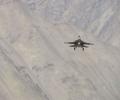
The entire base is seeing a flurry of activity and is playing a crucial role in enhancing the combat preparedness of the country along the China border.

'We must acknowledge China will use Pakistan against India.' 'We all need to know that these two countries are ready to destabilise India at all times.'
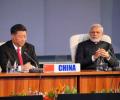
'Under General Secretary of the Chinese Communist Party (CCP) Xi Jinping, Beijing has stepped up its aggressive foreign policy toward New Delhi. Since 2013, China has engaged in five major altercations with India along the Line of Actual Control (LAC),' said a brief issued by US-China Economic and Security Review Commission.

'And this mirror imaging is the most dangerous thing because it leads to tremendous misunderstandings.'
The Indian side is expected to present specific proposals at the talks to deescalate tension in Pangong Tso, Galwan Valley and Demchok -- the three areas in eastern Ladakh where the two sides have been on a bitter standoff for last one month, the sources said.
 © 2026 Rediff.com - Advertise with us - Disclaimer - Privacy Policy - Sitemap - Feedback - About us - Terms of use - Grievances